The name Kreuzlingen is derived from the Augustinian monastery "crucelin", which Bishop Ulrich I of Constance founded in 1125 at the gates of the bishop's town. The monastery was initially located on the Bellevue site, but was destroyed in 1633 in the aftermath of the Swedish siege of Constance and rebuilt on the present site in 1650. Since secularisation in 1848, the Pädagogische Maturitätsschule has been located in the monastery buildings.
The largest Swiss city at Lake Constance
Kreuzlingen offers the most comprehensive range of educational opportunities in the canton of Thurgau, excellent sports facilities and a diverse cultural landscape. We appreciate your interest and invite you to get an idea of Kreuzlingen.
Virtual tour
See for yourself: Click on the image below and enjoy the virtual tour of Kreuzlingen (German).

Beautiful prospects for Kreuzlingen (German)
The image brochure «Beautiful prospects for Kreuzlingen» («Schöne Aussichten für Kreuzlingen») reflects our modern and dynamic city. Find short texts, up-to-date facts and figures and strong imageries.
(4 MB)
From «crucelin» to «Kreuzlingen»

Together with the Basilica of St. Ulrich, the monastery is the most important sight in the town.
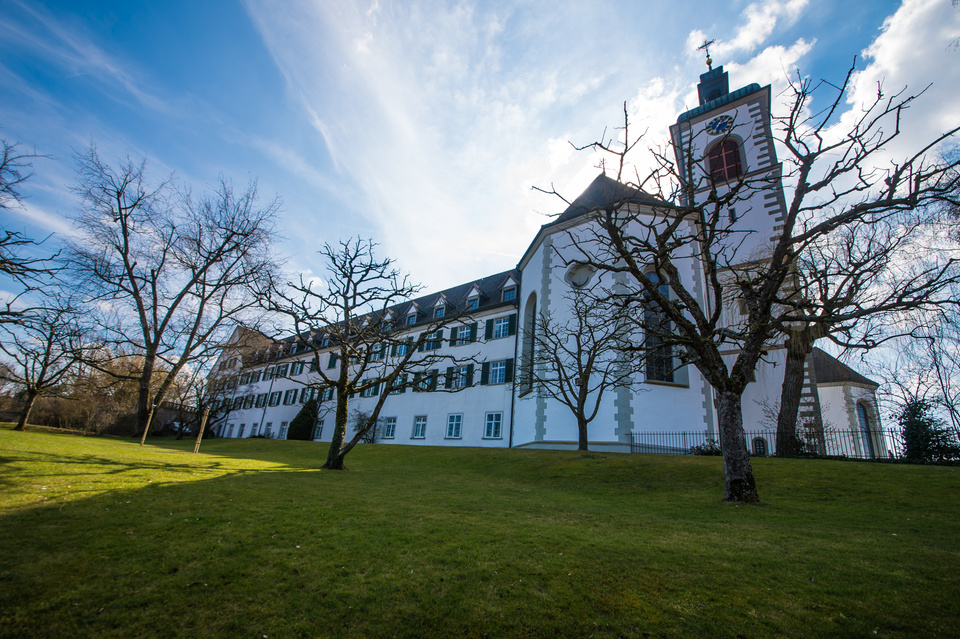
Together with the Basilica of St. Ulrich, the monastery is the most important sight in the town.

The colours of the coat of arms are red and white. The cross (left) refers to "crucelin", the bishop's crozier (right) emphasises the monastic past.
Stadt Kreuzlingen
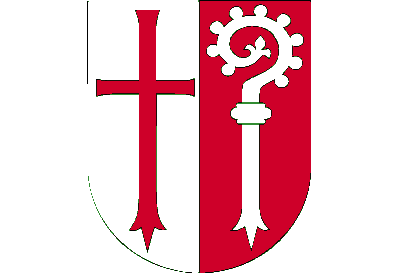
The colours of the coat of arms are red and white. The cross (left) refers to "crucelin", the bishop's crozier (right) emphasises the monastic past.
Stadt Kreuzlingen
The border town of Kreuzlingen was formed in the last century by the merger of the municipalities of Kreuzlingen-Egelshofen with Kurzrickenbach (1927) and Emmishofen (1928). In 1946, a municipal parliament with 30 members was elected for the first time. One year later Kreuzlingen became a town with its 10,000th inhabitant. Since 1971, the municipal parliament has comprised 40 people.